Local-first privacy
Local models are first-class. Every source of context — clipboard, files, notifications, screen — is gated by per-source permissions, default-deny.
Ask anything about your Linux system and get answers grounded in real data — while seeing exactly what, if anything, leaves your machine. Veya is an open-source, local-first AI assistant for Ubuntu/Linux: an Apple Intelligence alternative that runs on local models first and logs every cloud call.
you › anything urgent in my notifications?

veya › Yes — a failing CI run on veya#214 and a 3pm
        meeting that moved to 4. The rest can wait.
       ↳ Mistral (cloud) · 0.9 KB sent · logged to audit
A global overlay — summon it anywhere, ask anything about your system, get an answer backed by real data.
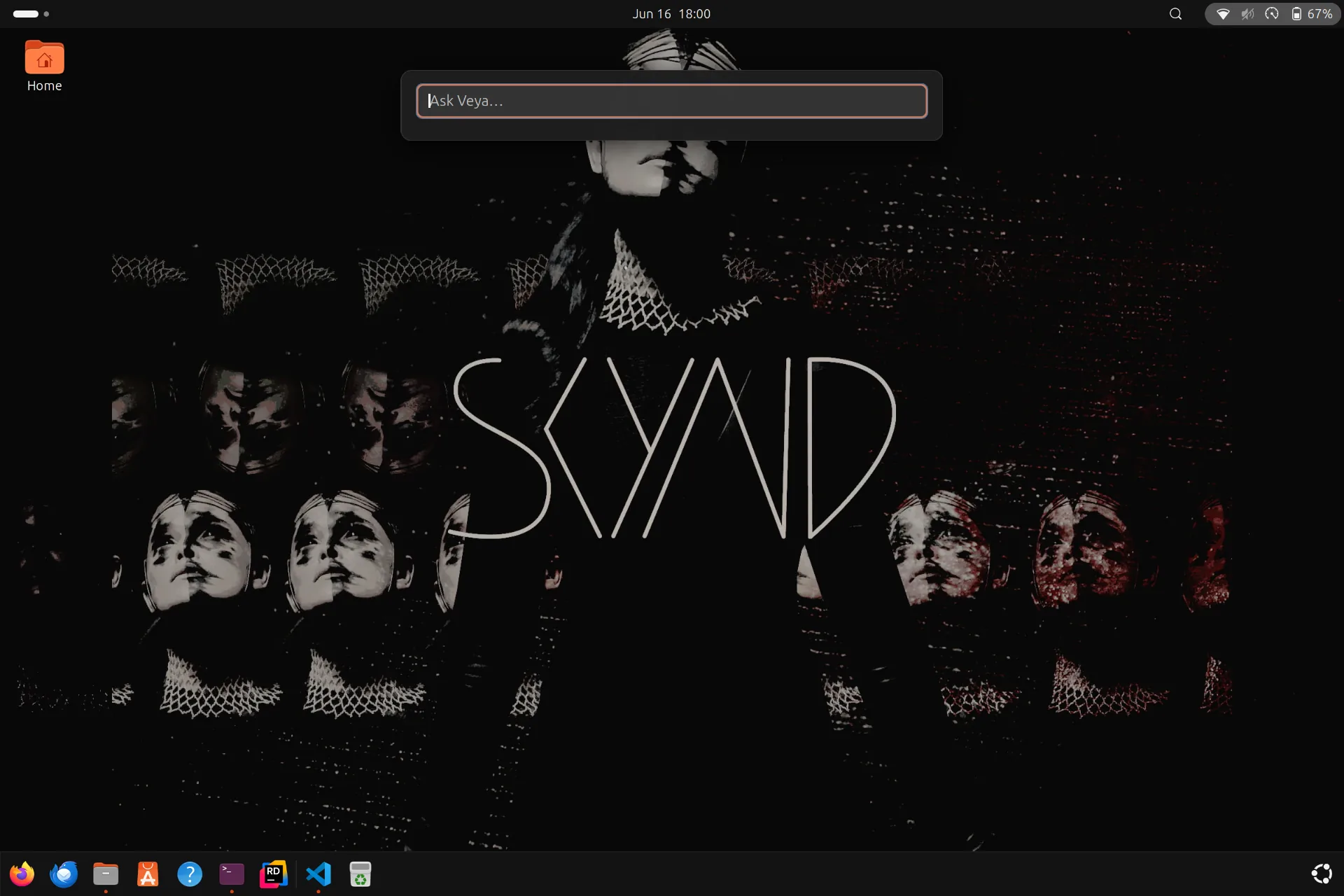
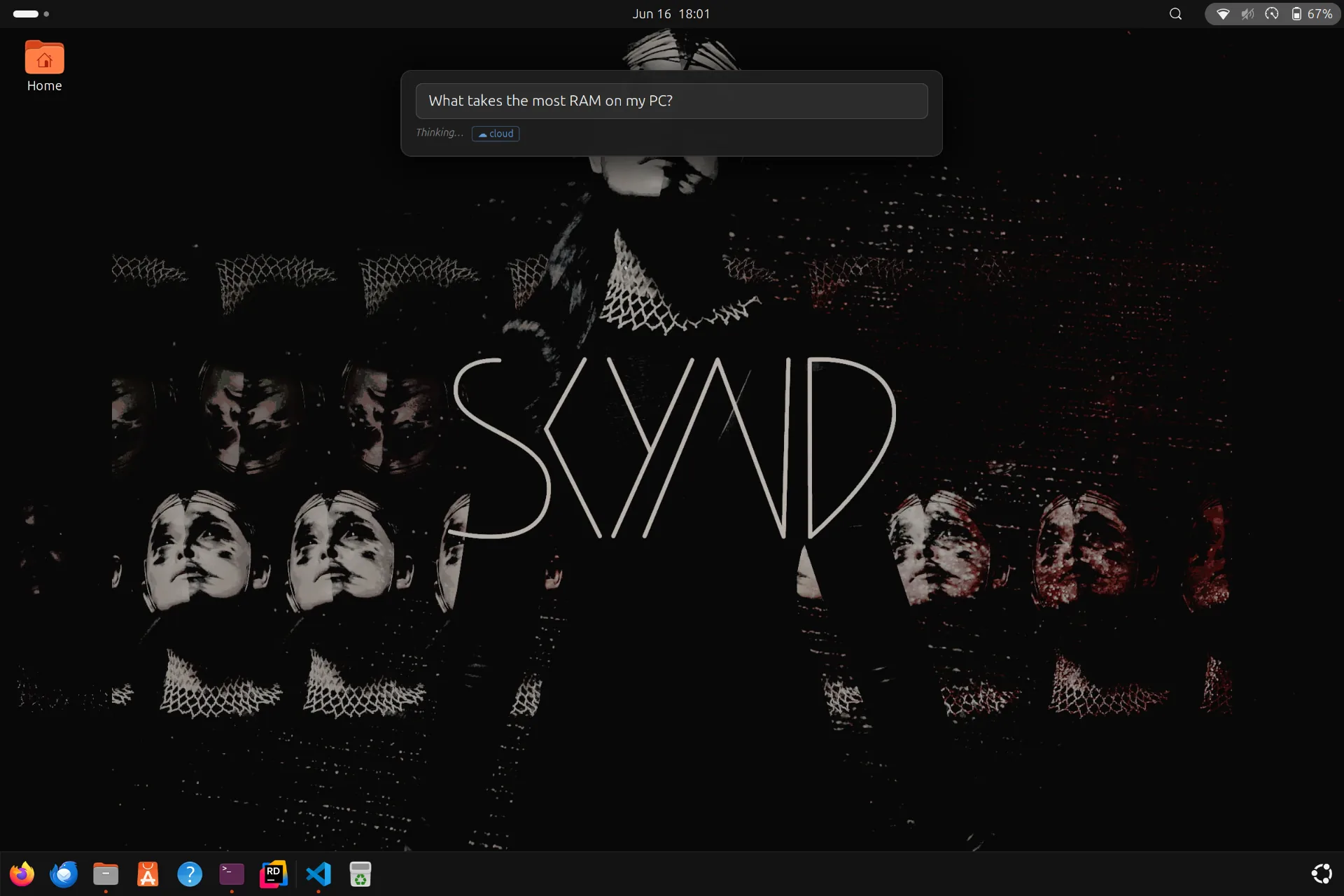
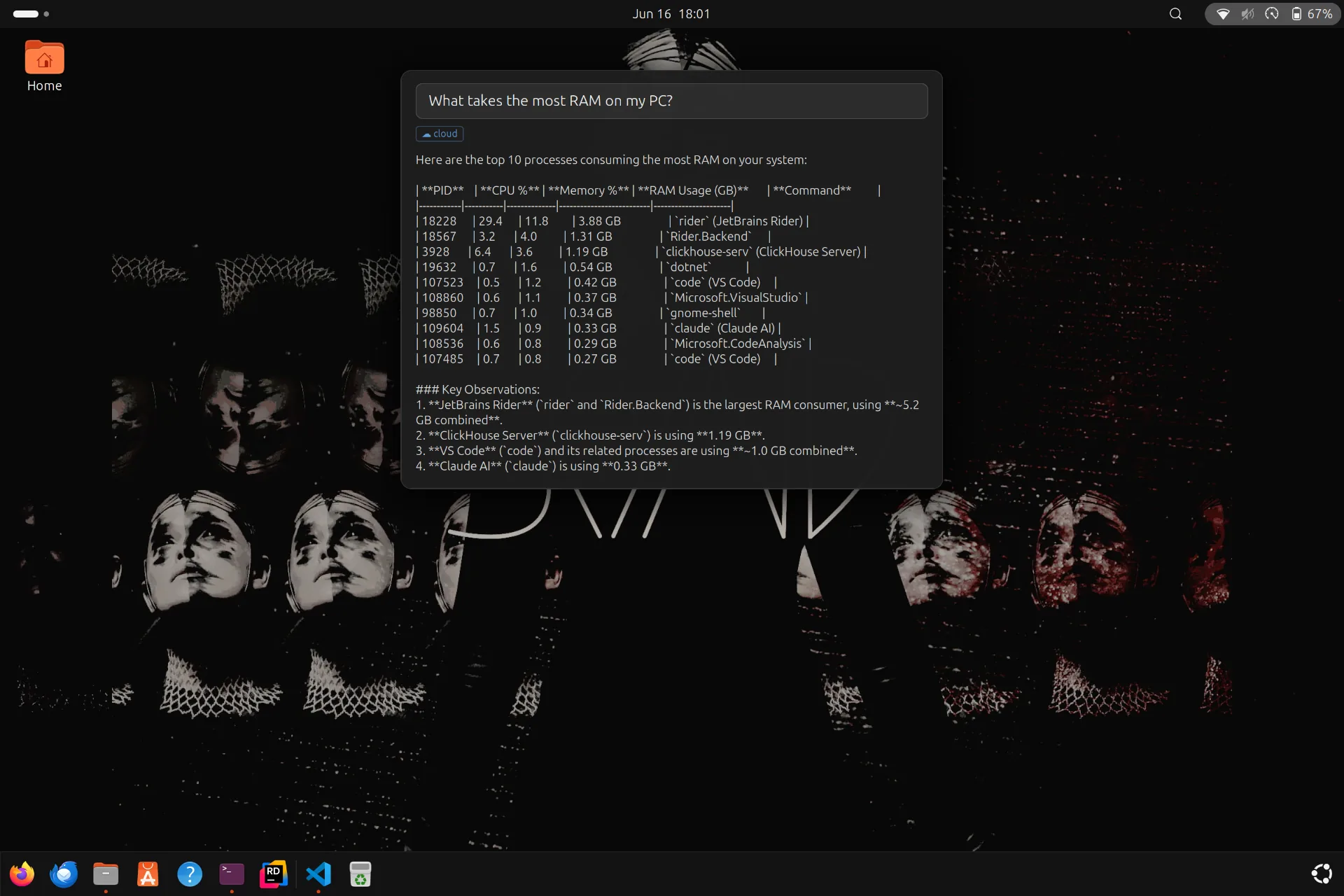
Local models are first-class. Every source of context — clipboard, files, notifications, screen — is gated by per-source permissions, default-deny.
An audit log records every tool invocation and every cloud request — backend, model, token counts, never the content. Cloud usage is always user-visible, surfaced live over D-Bus.
One daemon, one D-Bus contract (org.veya.Veya1), any
number of frontends — GTK4 overlay window, GNOME Shell extension
(keyboard summon, mic button), CLI, or your own client.
A central daemon owns all intelligence. Frontends are thin clients over D-Bus; system access is isolated in an MCP server behind a safety layer.
---
config:
  theme: base
  themeVariables:
    background: '#0b0e14'
    mainBkg: '#151a26'
    primaryColor: '#151a26'
    primaryBorderColor: '#232a3a'
    primaryTextColor: '#e6e9f0'
    lineColor: '#6ea8fe'
    edgeLabelBackground: '#0b0e14'
    clusterBkg: '#11151f'
    clusterBorder: '#232a3a'
    titleColor: '#e6e9f0'
    fontFamily: 'ui-sans-serif, system-ui, sans-serif'
    fontSize: '13px'
---
flowchart TD
    subgraph FE[Frontends]
        UI["Overlay UI\nGTK4 / Gir.Core"]
        GS["GNOME Shell ext\nGJS · keyboard summon · mic"]
        CLI[CLI]
    end

    subgraph D["Daemon — Veya.Daemon"]
        DCore["sessions · context\nper-source permissions · audit log"]
        Router["model router · FallbackInferenceBackend"]
        Ctx["personal context index\nSQLite + sqlite-vec · local embeddings"]
        Notif["notification intelligence\ncapture · digest · answer"]
        Voice["voice I/O · AskVoice\nWhisper STT · espeak-ng TTS · local"]
        DCore --> Router
        DCore --- Ctx
        DCore --- Notif
        DCore --- Voice
    end

    FE -->|"D-Bus · org.veya.Veya1"| D

    Router --> Ollama["Ollama\nlocal · no cloud egress"]:::local
    Router --> Mistral["Mistral (default)\ncloud · user-visible"]:::cloud
    Router --> Claude["Claude (optional)\ncloud · user-visible"]:::cloud

    D -->|"MCP over stdio"| MCP["McpServer — Veya.McpServer\nread-only: system info · processes · memory/disk · journald · APT · systemd\nwrite (permission-gated): set_clipboard · read_screen_text\nsafety layer: allowlist · timeouts · output caps · audit log"]

    MCP --> OS["Ubuntu system\nunprivileged · polkit later"]

    classDef local fill:#0d1a12,stroke:#4ade80,color:#4ade80
    classDef cloud fill:#130d1f,stroke:#b388ff,color:#b388ff
Long-running user service. Owns sessions, context, permissions, the audit log, and the model router. Local-first FallbackInferenceBackend: try Ollama, fall back to the configured cloud backend (Mistral by default, Claude optional). Folds personal context and notification digest into every answer.
System-action layer over the MCP protocol. Read-only tools: system info, processes, memory/disk, journald, APT, systemd. Write tools: set_clipboard and read_screen_text (screen awareness) — both permission-gated behind the central safety layer.
Personal context index grounds answers in user-approved files via local embeddings + SQLite/sqlite-vec. Notification intelligence captures and digests desktop notifications. Both permission-checked, both degrade gracefully when denied.
Every shell command goes through an allowlist, timeouts, output caps, and the audit log. Daemon and MCP server run unprivileged as user services.
Milestones 1–4 are done. Everything builds on the same daemon + D-Bus + MCP spine.
Daemon skeleton, D-Bus Ask, MCP server with read-only system tools, Claude API backend, minimal overlay window.
Ollama local backend; config-selectable cloud tier — Mistral (default) or Claude; local-first FallbackInferenceBackend; permission-gated clipboard write.
Embeddings index (SQLite/sqlite-vec) over user-approved files; notification capture and digest — summarize, prioritize, answer. Both permission-gated and audit-logged.
Screen awareness (read_screen_text via XDG portal + Tesseract) ✓ — GNOME Shell extension (keyboard summon, cloud badge, mic button) ✓ — Voice I/O (local Whisper STT + espeak-ng TTS via AskVoice) ✓.
Next: packaging (Flatpak + .deb) so anyone can install Veya, a second frontend beyond GNOME to prove the D-Bus contract, and privileged write actions through polkit (ADR-0003) — acting on the system, not just reading it, without ever assuming root.
One issue per branch; every PR runs the canonical build + test + format check in CI. Contributions are accepted under the same license and require a Developer Certificate of Origin sign-off.
git clone https://github.com/s3ba-b/veya.git
Build & run instructions live in the repo’s README.
Star it on GitHub